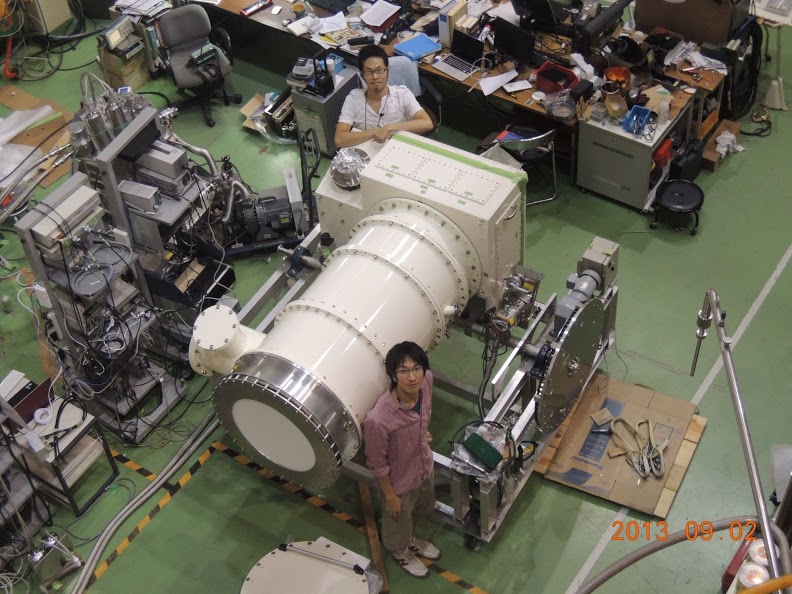
POLARBEAR-2 (PB2) is a Stage-3 CMB experiment that was deployed at the Chajnantor Observatory in late 2018. PB2 contains more than 7,000 polarization-sensitive detectors that observe the sky at 90 GHz and 150 GHz simultaneously on a PB1-style telescope. PB2 is led by Adrian Lee at UC Berkeley, Brian Keating at UC San Diego, and Masashi Hazumi at the High Energy Accelerator Research Organization (KEK) in Japan.
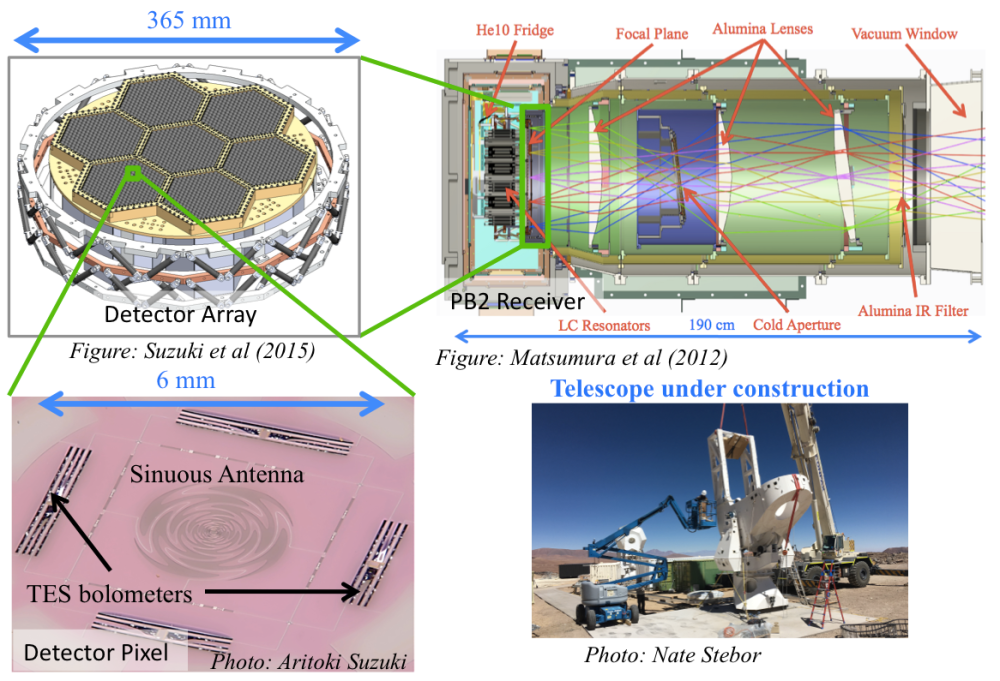
PB2 is projected to be five times more sensitive than PB1, making it well suited to measure B-modes due to both gravitational distortions by large-scale structure and B-modes due to gravitational waves generated during inflation.

My contribution to POLARBEAR-2 has primarily been designing, building, and testing its ambient-temperature continuously-rotating half-wave plate polarization modulator. Specifically, I developed the optical design which utilizes a stack of 20″-diameter sapphire wafers and a two-layer plastic anti-reflection coating to achieve outstanding efficiency across both PB2 frequency channels. In addition to half-wave plates, I have performed instrument modeling, detector evaluation, and optical characterization for PB2.
For more information on PB2, visit the POLARBEAR website!
 Charles Alexander Hill