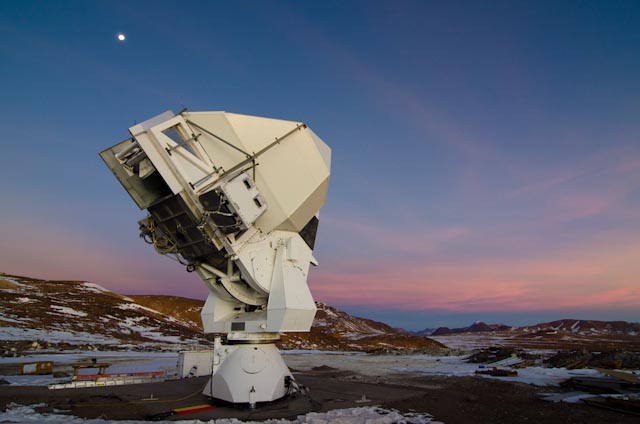
POLARBEAR-1 (PB1) was a Stage-2 cosmic microwave background (CMB) experiment located at the Chajnantor Observatory in the Atacama Desert of northeastern Chile and began observations in 2012. The project was led by Adrian Lee at UC Berkeley and was decommissioned in 2019.
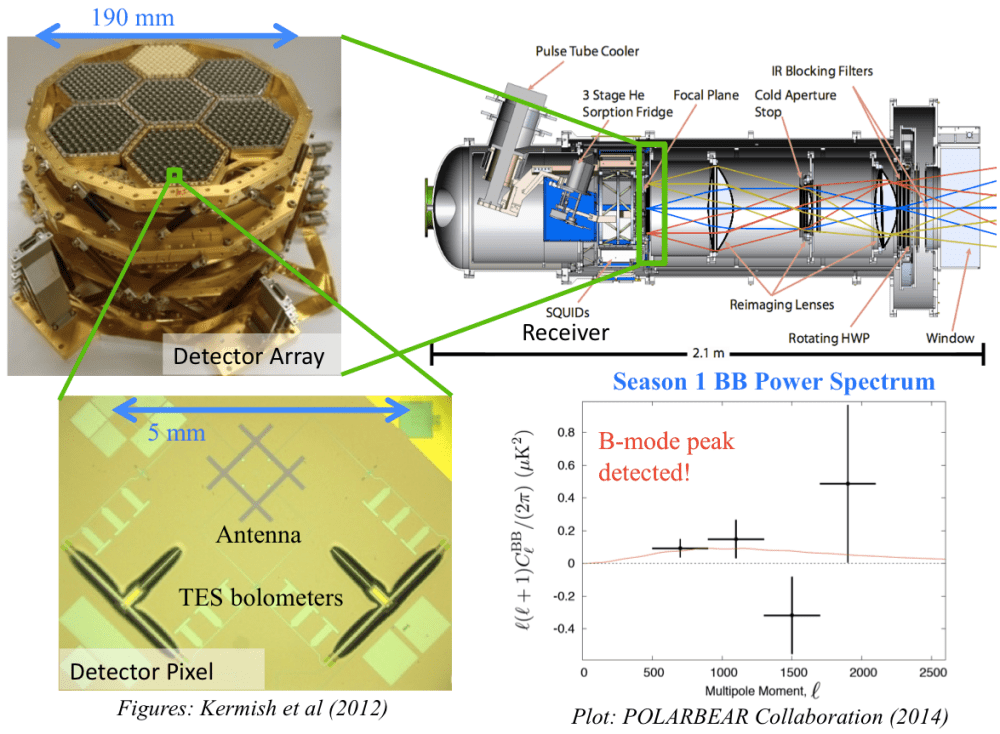
The PB1 receiver contains more than 1,200 polarization-sensitive detectors that observe the sky via a three-meter-diameter telescope at 150 GHz. A PB1 detector pixel consists of a double-slot dipole antenna and two polarization-sensitive transition edge sensor (TES) bolometers. PB1 made the first ever statistically-significant, polarization-only, non-zero detection of the “B-mode” polarization pattern induced by distortion of the CMB by large-scale gravitational structure.

My contribution to PB1 was primarily telescope and site maintenance. During 2014 ~ 2016, I regularly babysat the experiment remotely using a custom web interface developed by Yuji Chinone, and I also visited Chile for 4 weeks in August of 2014 to perform a routine checkup and minor upgrades to site infrastructure.
For more information about PB1, visit its website!
 Charles Alexander Hill